







Leave nothing to chance
Surgical site complications (SSCs)—including Surgical Site Infections (SSIs), dehiscence, and seromas—put patients at risk and strain healthcare systems, with conventional incision management often falling short.28-33 But recovery shouldn’t be left to chance.
The PICO System is the first Negative Pressure Wound Therapy System, to be indicated to aid in the reduction of the incidence of both superficial and deep incisional SSIs on high-risk patients, in Class I and Class II wounds, post-operative seroma and dehiscence on closed surgical incisions* Make evidence-based decisions that help protect incisions. Leave nothing to chance.
*PICO 7/14 Systems
Don't let your patient become part of the statistics
Not every procedure will result in a SSC…but all SSCs will have an effect on resources, costs and patient wellbeing. Data from the US highlights the scale of the problem each year; reinforcing a need to reshape post-operative incision care. Flip the cards to reveal the problem.

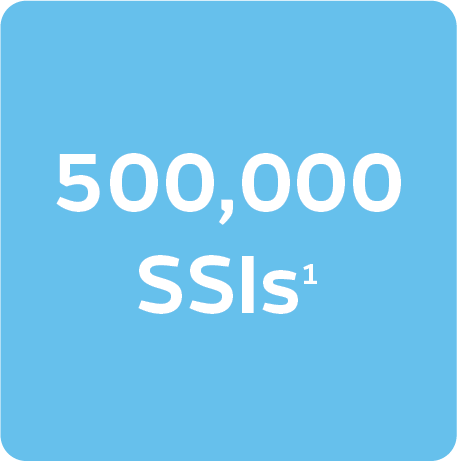



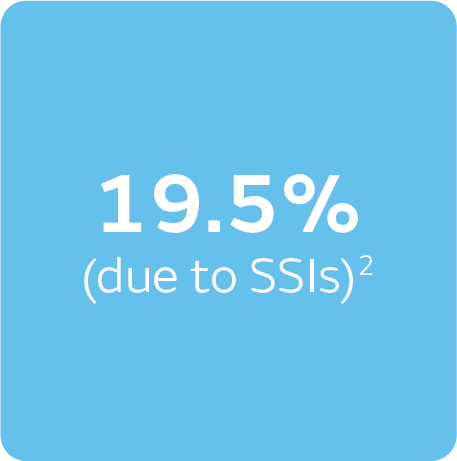


In any given year, data suggests healthcare systems have to deal with half a million SSIs,1 constituting 19.5% of all readmissions2 and costing 8,000 lives.1 Furthermore, an estimated $13.1 billion of Medicare funding is spent on non-healing or infected surgical wounds.3
Consider how SSCs disrupt your workloads, budgets and patients…then explore how the introduction of PICO sNPWT could made a substantial difference.
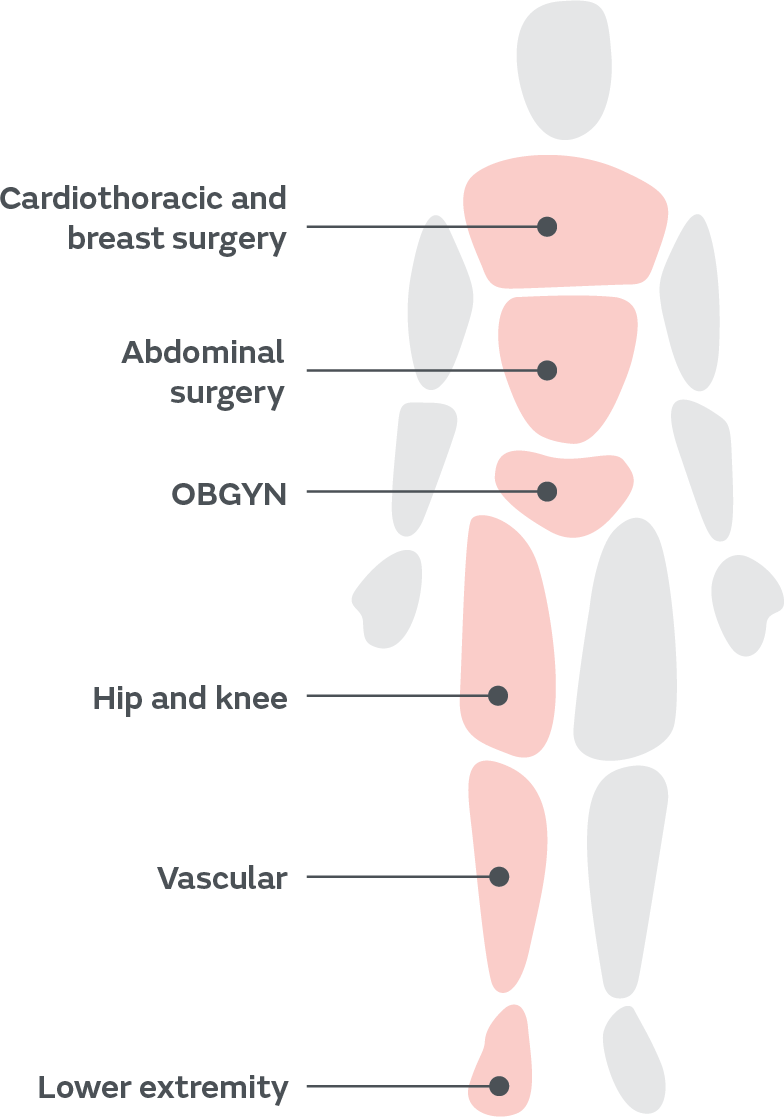
There is a risk for procedures to result in complications
Once SSCs develop, the costs, delays and impact on patients’ quality of life might be unavoidable. Go from reactive treatment to proactive prevention across a broad range of indications and leave nothing to chance with PICO sNPWT.

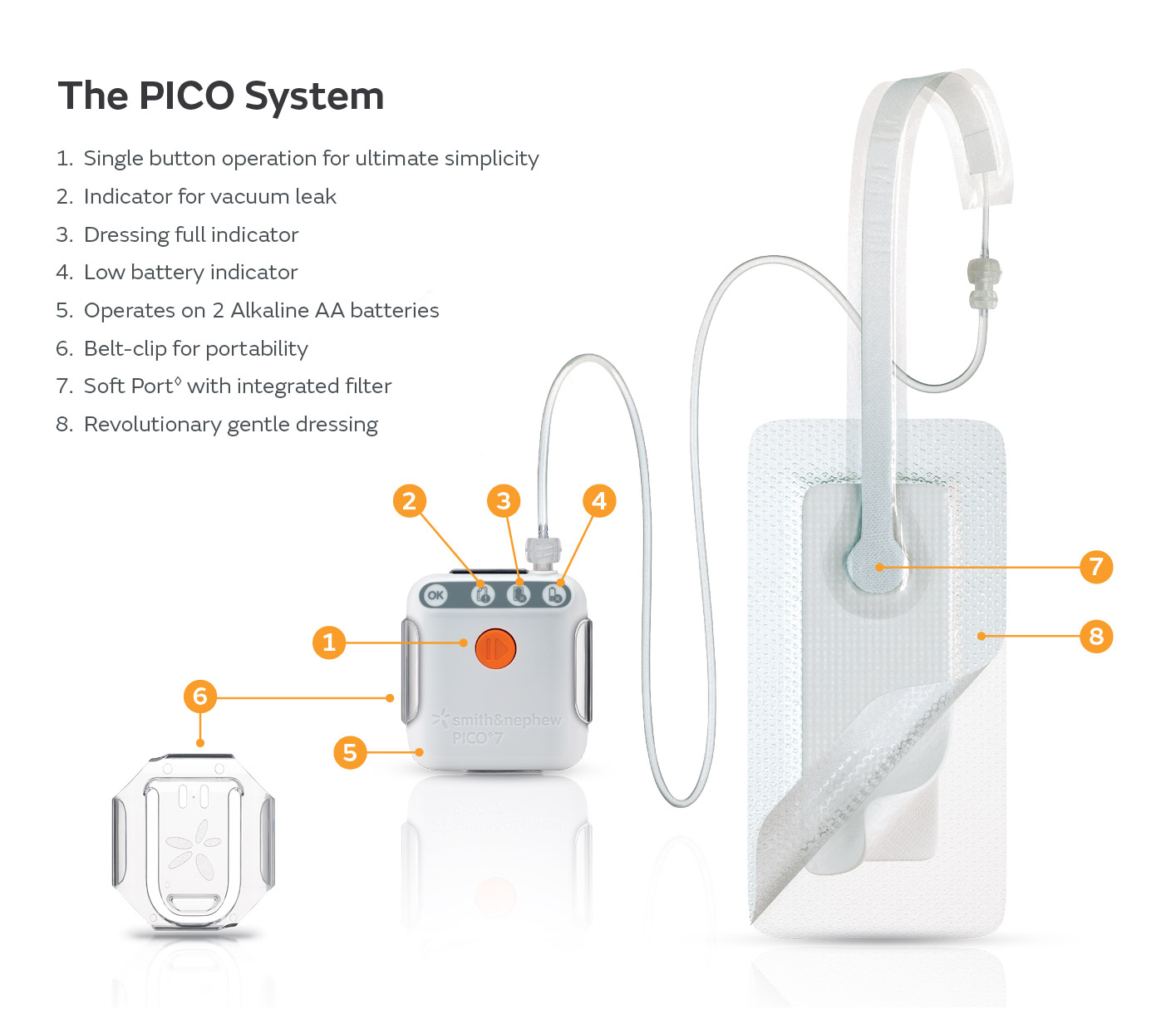
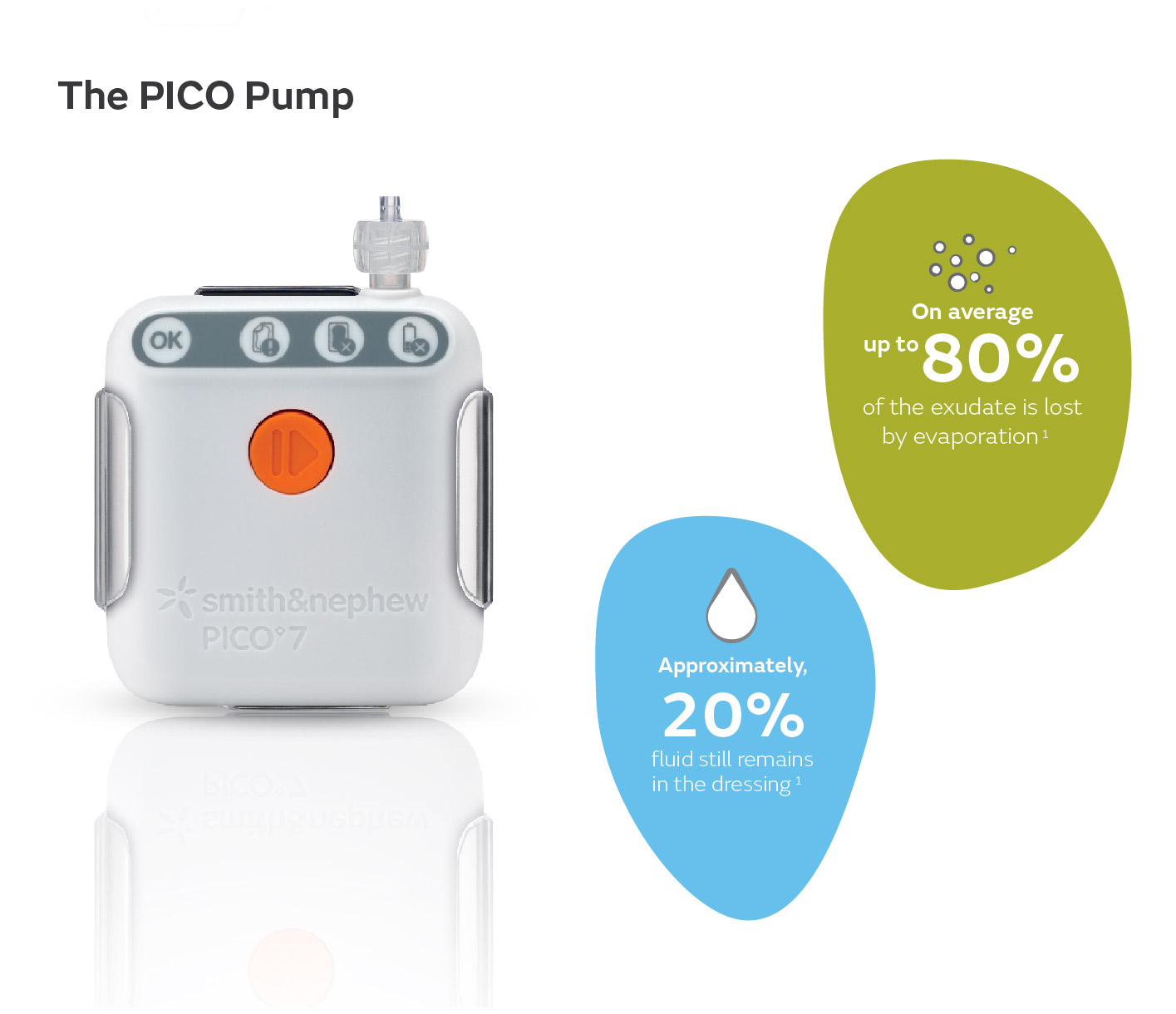
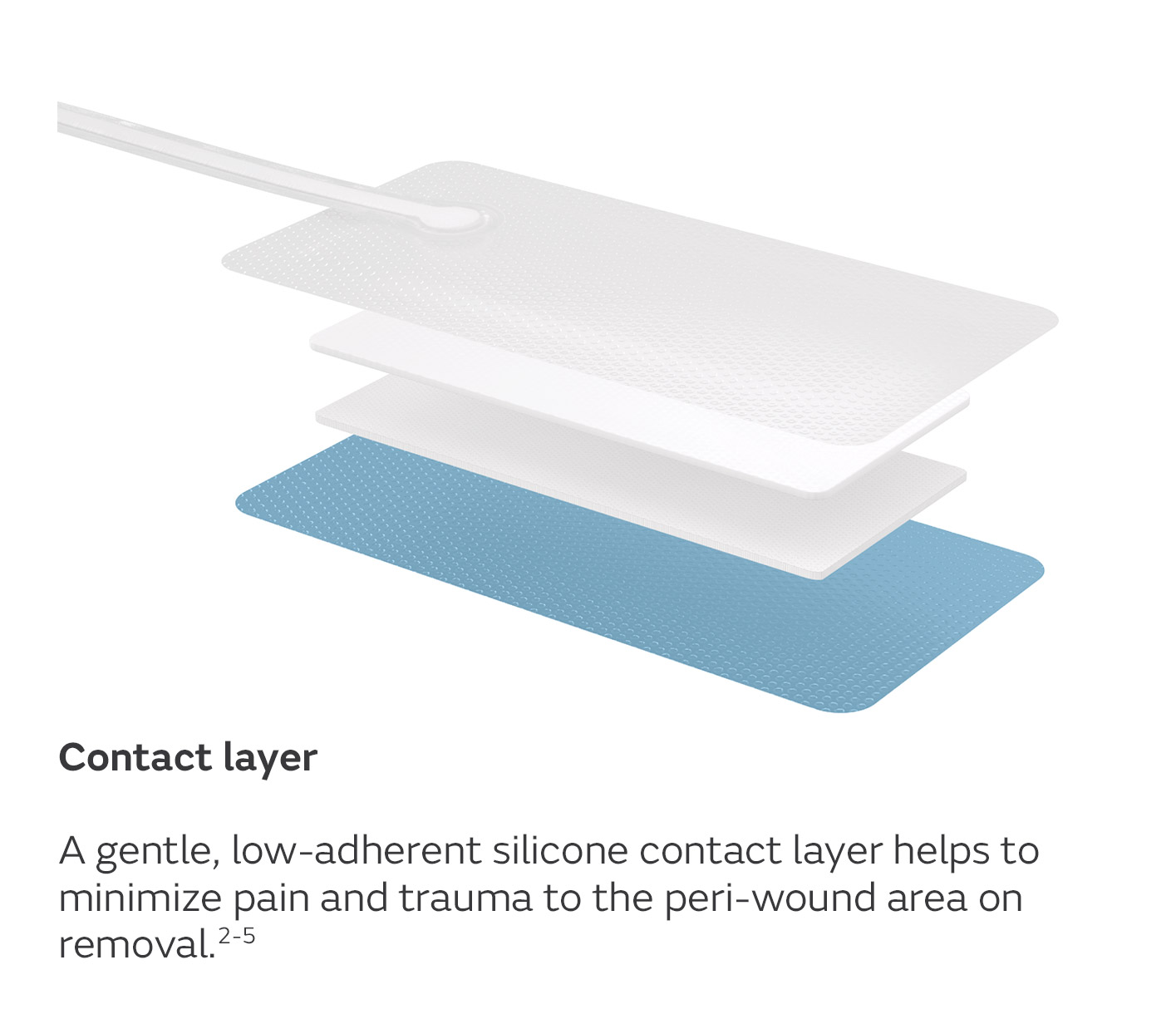
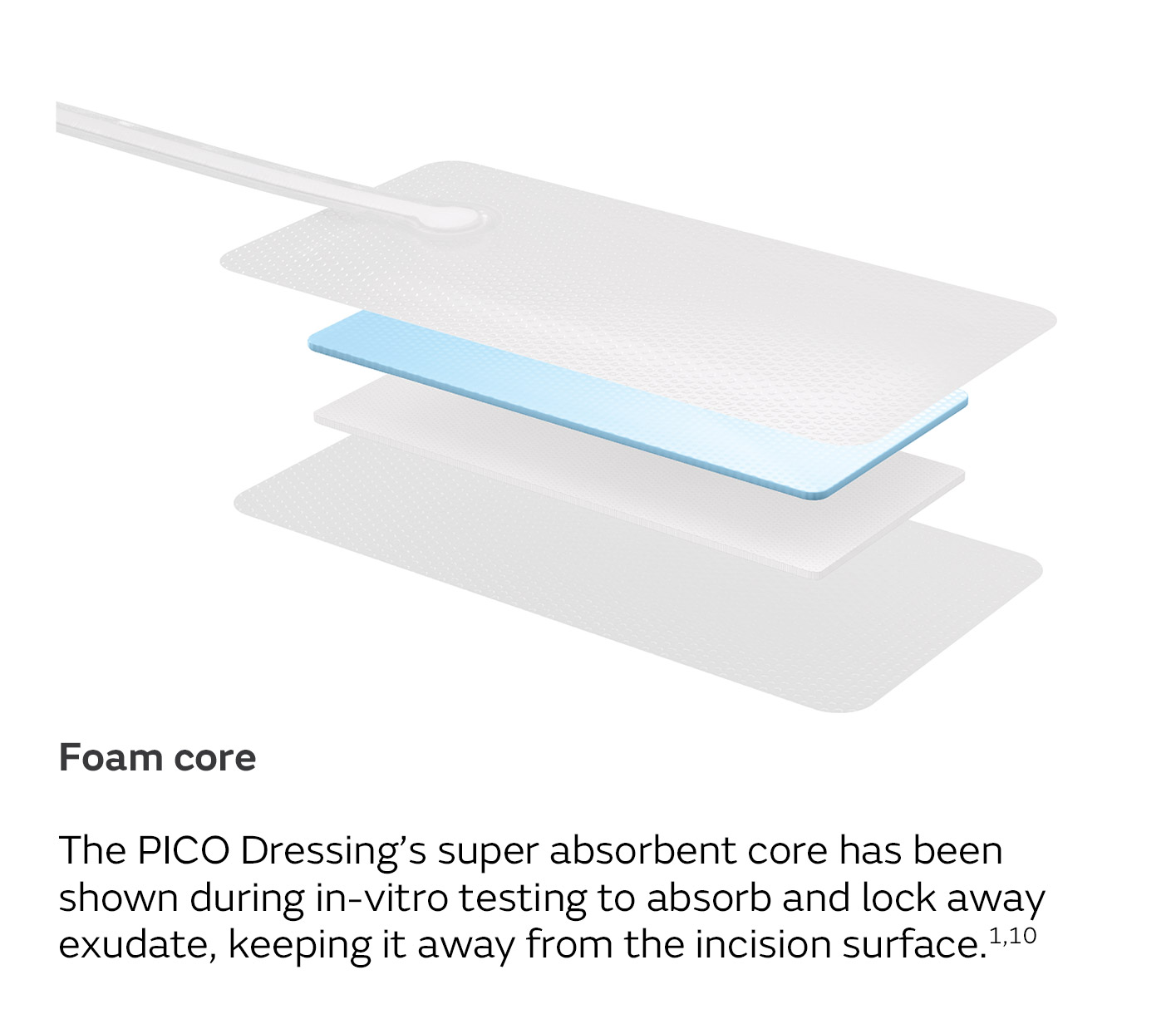
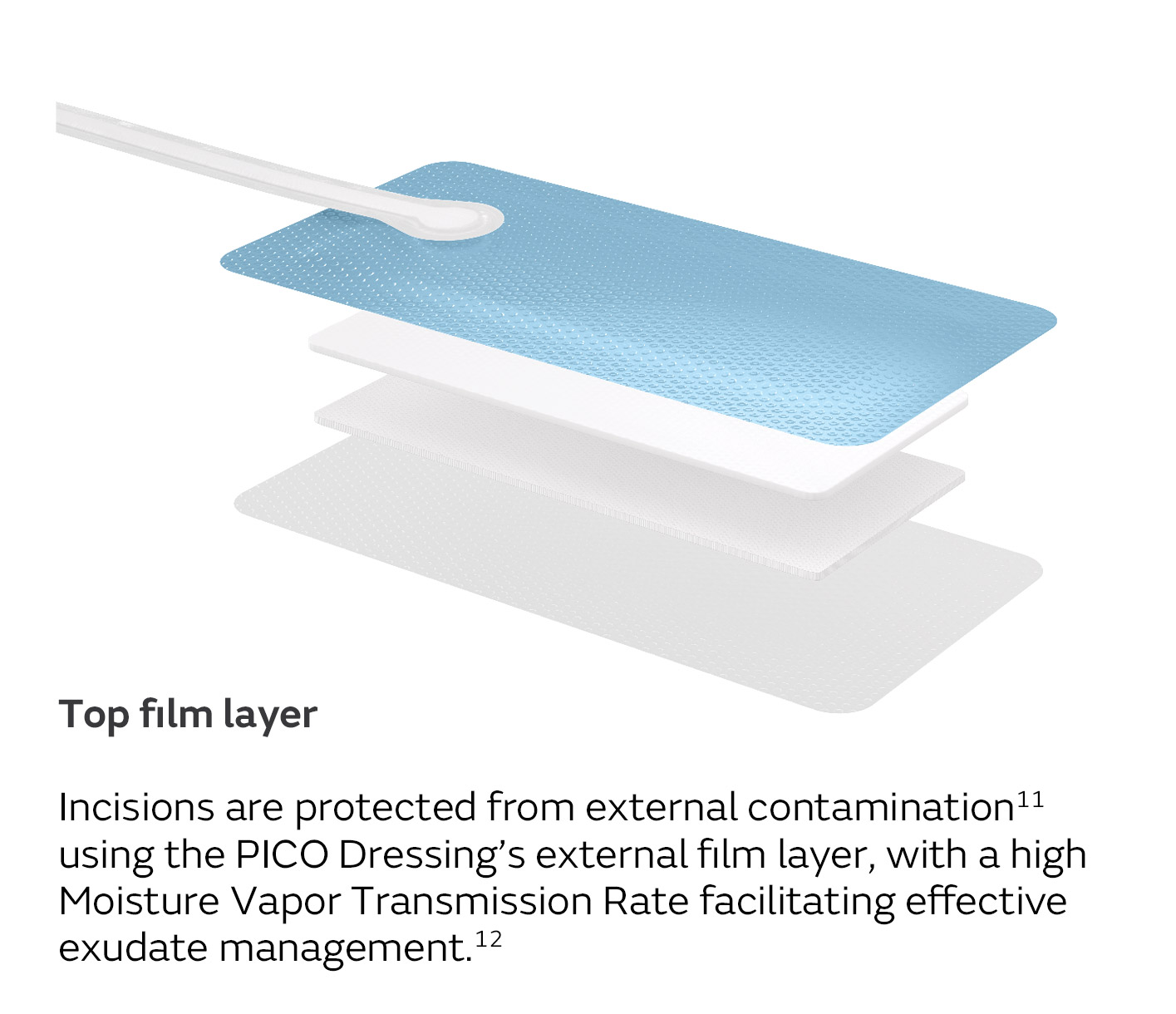
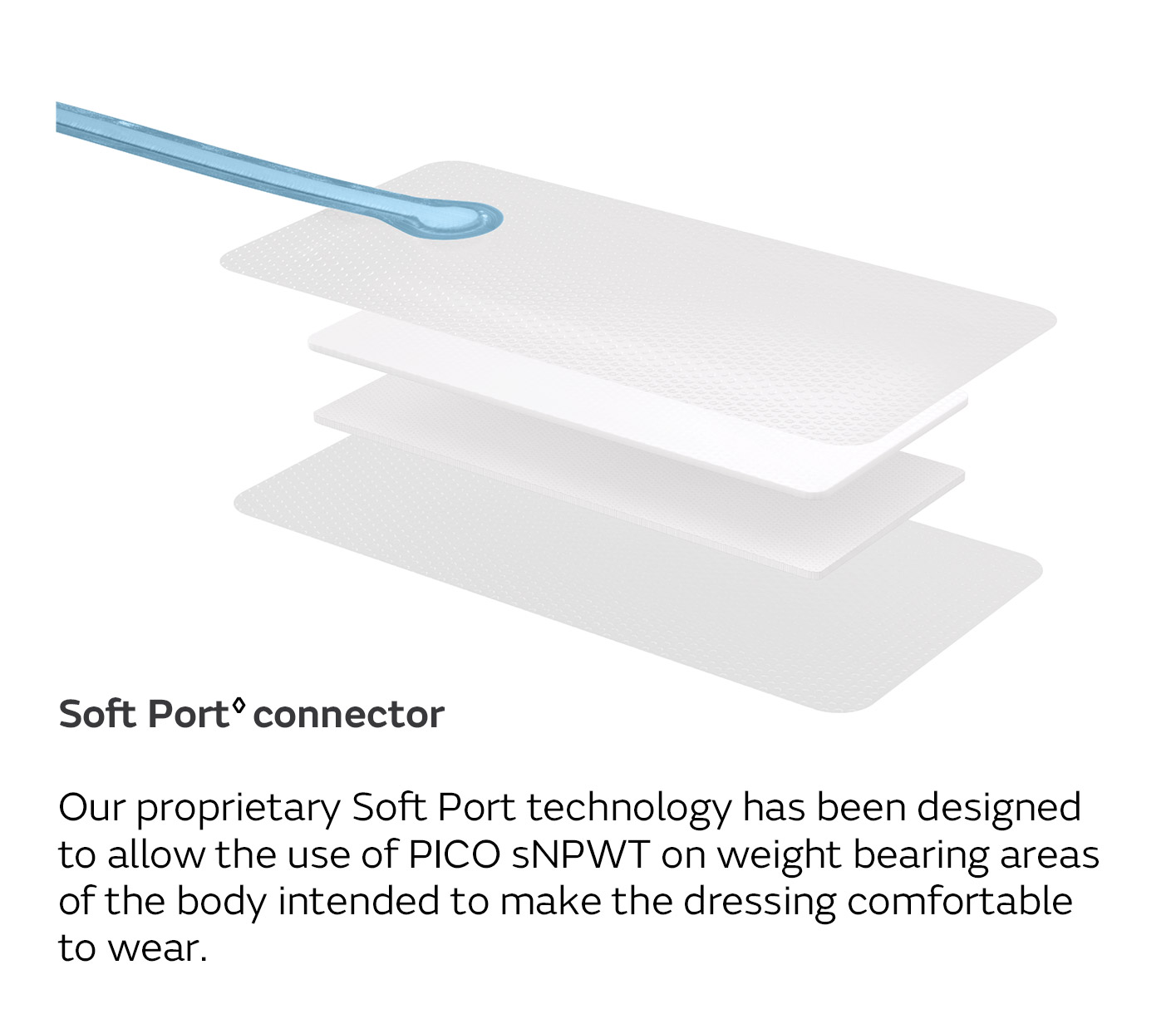
The PICO System's mode of action
Learn how PICO works from the inside out.
Improved quality and appearance of scars
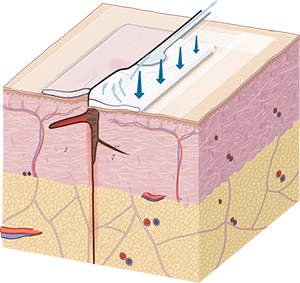
PICO System has been shown to significantly improve the quality and appearance of scars when applied post-operatively.*11
*Compared to care with standard dressings; p0.001
Protects from contamination
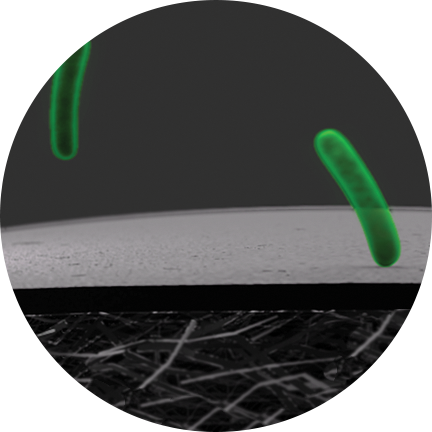
Reduces established mature biofilm and absorbs bacteria from the wound, locking it into the dressing. All while protecting from outside contamination. 2,3
Promotes lymphatic drainage
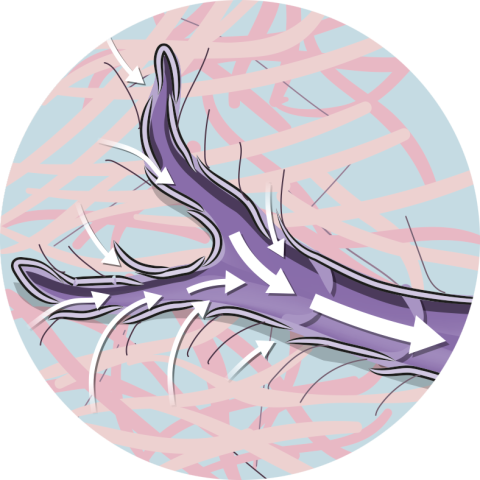
Helps to promote lymphatic drainage*4
*As demonstrated in vivo.
Improves blood flow
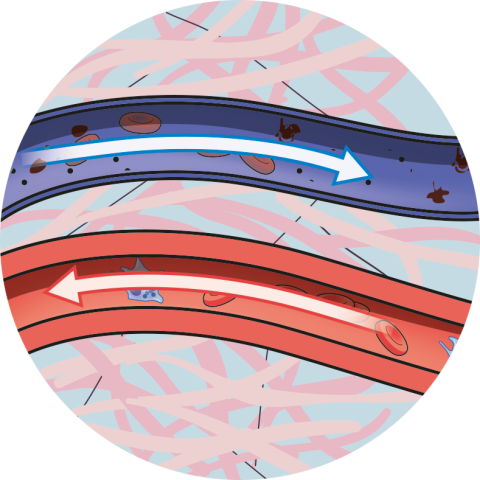
Maintains an efficient blood supply to the wound (perfusion), which helps to support immune response.5-7
Moist wound environment

Provides a moist environment which helps with healing.12-15
Holds incision together
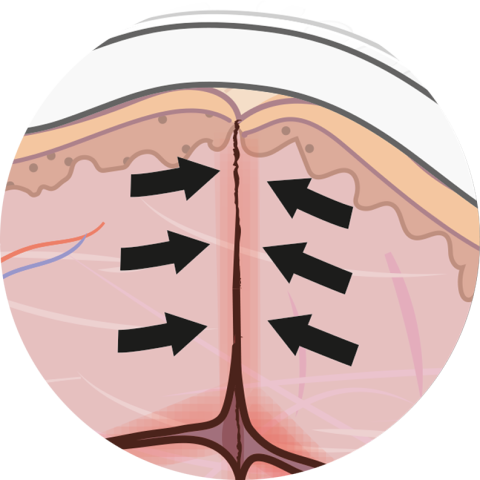
Holds closed incision together, reducing lateral tension forces across the incision.†1
†As demonstrated in biomechanical modeling.
Helps reduce edema
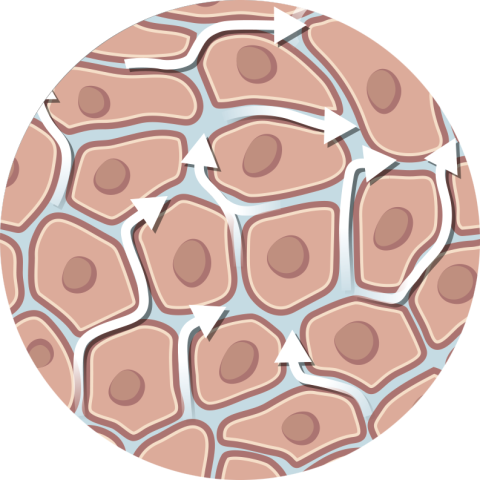
Increase the efficiency of functional lymph vessels which helps to reduce fluid buildup.8-10
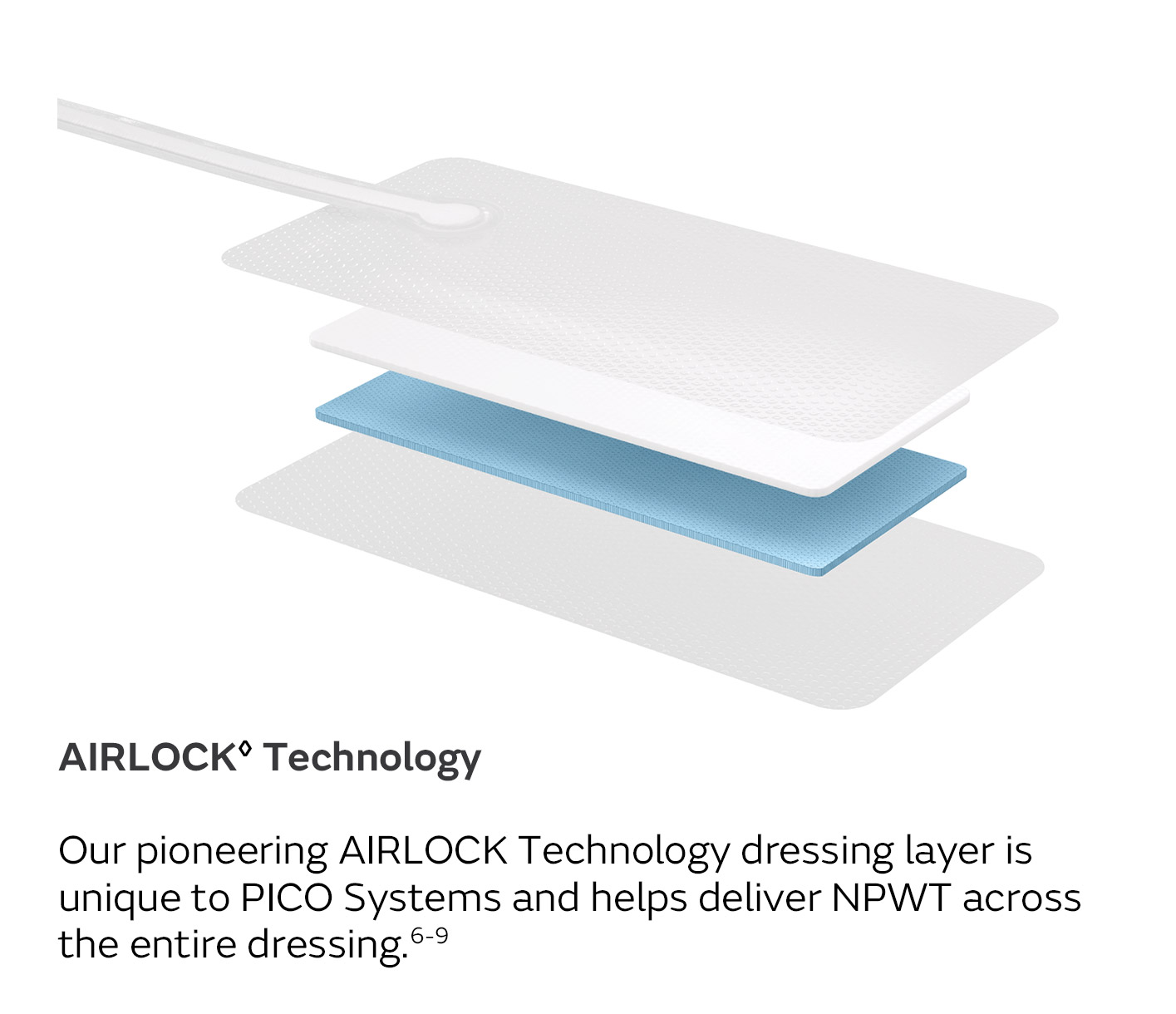
Wider zone of compression
AIRLOCK Technology provides consistent delivery of NPWT (nominal 80mmHg) over a wide zone, beyond the wound itself, allowing for effective NPWT over the wound and periwound area.17
PICO sNPWT delivers compressive forces to tissues that span the entire dressing.17,9

Clinical evidence
For the risk of SSCs, clinical data continues to reinforce how using PICO sNPWT on suitable patients can have a profound influence on outcomes when compared to standard care.


See what Gloria has to say about the PICO System.
See why Dr. Gray uses the PICO System.
Choose your specialty
Orthopedics

for orthopedics
Obstetrics and gynecology
for OBGYN
Breast/plastics

for breast/plastic surgery
Cardiothoracic

for cardiothoracic surgery

Abdominal/open

for abdominal surgery
Mode of Action references
- Loveluck J, et al. ePlasty. 2016;16:183-195.
- Galiano RD, et al. PlastReconstr Surg Glob Open. 2018;6(1):e1560.
- Pellino G, et al. Surg Innov. 2014;21(2):204–212.
- Kilpadi DV, et al. Wound Repair Regen. 2011;19(5):588-596.
- Malmsjö M, et al. ePlasty. 2014;14:1-15.
- Ma Z, et al. Exp Ther Med. 2016;11(4):1307-1317.
- Xia CY, et al. Mol Med Rep. 2014;9(5):1749-1754.
- Birke-Sorensen H, et al.. Journal of plastic, reconstructive and aesthetic surgery: JPRAS 64 Suppl, S1–S16 (2011)
- Scalise A, et al. Int Wound J. 2016;13:1260–1281.
- Shim HS, et al. Biomed Res Int. 2018;2018
- R. G, R. D, J. S, et al. The effects of a single use canister-free Negative Pressure Wound Therapy (NPWT) System* on the prevention of post surgical wound complications in patients undergoing bilateral breast reduction surgery. Paperpresented at: The British Association of Aesthetic Plastic Surgeons (BAAP's) 30th Annual Scientific Meeting; 2014; London.
- Hudson DA, Adams KG, Van Huyssteen A, Martin R, Huddleston EM. Simplified negative pressure wound therapy: clinical evaluation of an ultraportable, no-canister system. Int Wound J. 2015;12(2):195-201.
- Kirsner R, Dove C, Reyzelman A, Vayser D, Jaimes H. A Prospective, Randomised, Controlled Clinical Trial on the Efficacy of a single-use Negative Pressure Wound Therapy System, compared to Traditional Negative Pressure Wound Therapy in the Treatment of Chronic Ulcers of the Lower Extremities. Wound Repair Regen. 2019;27(5):519 - 529.
- Smith+Nephew 2018.Summary of rountine QA testing on MVP of PICO dressings. 2018. Internal Report. DS/18/153/R.
- Smith+Nephew 2019.Use of Moisture Vapour Permeability* (MVP) and Moisture Vapour Transmission rate** (MVTR) data to support product claims referring to moist wound healing. Internal Report. EO.AWM.PCSgen.001.v2.
PICO active incision management references
- Malmsjö M, Huddleston E, Martin R. Biological Effects of a Disposable, Canisterless Negative Pressure Wound Therapy System. ePlasty. 2014;14:1 - 15
- Hudson DA, Adams KG, Van Huyssteen A, Martin R, Huddleston EM. Simplified negative pressure wound therapy: clinical evaluation of an ultraportable, nocanister system. Int Wound J. 2015;12(2):195-201.
- Payne C, Edwards D. Application of the Single Use Negative Pressure Wound Therapy Device (PICO) on a Heterogeneous Group of Surgical and Traumatic Wounds. ePlasty. 2014:152-166.
- Stryja J, Staffa R, Říha D, Stryjová K, Nicielniková K. Cost-effectiveness of negative pressure wound therapy in outpatient setting. Prolekare. 2015;94(8):322 - 328.
- Smith+Nephew November 2018.The Review Of Evidence Supporting The Use Of PICO In Wounds ≥2cm In Depth. Internal Report. EO.AWM.PCS230.001.v2.
- Casey C. Consistent delivery of therapeutic negative pressure levels by a singleuse negative pressure wound therapy system (sNPWT)* in a wound model. Paper presented at: EWMA; 2019; Gothenburg, Sweden
- Smith+Nephew January 2019.Air Leak Tolerance Report: A comparison of PICO v2 (PICO 7 and PICO 14) Devices to PICO vl.6 (PlCO) Devices. Internal Report. RD/19/006.
- Smith+Nephew December 2018.PICO 14 Service Life Testing: 14 Day Device Lifespan. Internal Report. RD/18/132.
- Smith+Nephew 2021.PICO™ Pressure Mapping Study. Internal Report. DS/19/211/R - Part B.
- Smith+Nephew July 2018.PICO 7Y Non-NPWT Wound Model Summary. Internal Report. DS.18.260.R.
- Smith+Nephew 2020.Bacterial barrier testing of the PICO dressing. Internal Report. 2001002.
- Smith+Nephew 2018.Summary of rountine QA testing on MVP of PICO dressings. 2018. Internal Report. DS/18/153/R.
- Gilchrist B, Robinson M, Jaimes H. Performance, safety, and efficacy of a single use negative pressure wound therapy system for surgically closed incision sites and skin grafts: A prospective multi-centre follow-up study. Paper presented at: SAWC; 2020; Virtual
- Sharpe A, Myers D, Searle R. Using single use negative pressure wound therapy for patients with complicated diabetic foot ulcers: an economic perspective. Wounds UK. 2018;14(3):80-137.
- Myers D, Sharpe A. EP549 Service Delivery in Complex DFU Patients using Single Use NPWT - A UK Perspective. Paper presented at: EWMA; 2018; Krakow.
General references
- Najjar PA, et al. Surg Clin N Am 2015;95(2):269-283. World Union of Wound Healing Societies (WUWHS). Consensus Document: Closed surgical incision management: Understanding the role of NPWT. https://woundsinternational.com/world-union-resources/closed-surgical-incision-managementunderstanding-the-role-of-npwt/.
- Merkow, R, et al. JAMA, February 3, 2015, Volume 313, Number 5.
- Nussbaum SR, et al. An. Value Health. 2018 Jan;21(1):27-32.
- Olsen et al. J Am Coll Surg. 2008 Sep;207(3):326-35.
- Olsen MA, et al. Archives of Surgery. 2008 Jan 1;143(1):53-60.
- Cotogni P, et al. J Crit Care Med 2015;4(4): 265-273.
- Jenks PJ, et al. Journal of Hospital Infection, 2014; 86(1), pp.24-33.
- Tanner J, et al. Journal of Hospital Infection. 2009 Jul 1;72(3):243–50.
- Aicher B, et al. Journal of Vascular Nursing. 2017 Sep 1;35(3):146–56.
- Gwilym BL, et al. European Journal of Vascular and Endovascular Surgery. 2021 Jan 7.
- Smith+Nephew 2018. Internal Report. DS.18.260.R.
- Stryja J, et al. Prolekare. 2015;94(8):322 - 328.
- Smith+Nephew 2015. Internal Report. ST865 CT09/02.
- Hudson DA, et al. Int Wound J. 2015;12(2):195-201.
- Payne C, et al. ePlasty. 2014:152-166.
- Malmsjö M, et al. ePlasty. 2014;14:1 - 15.
- Casey C. Consistent delivery of therapeutic negative pressure levels by a single use negative pressure wound therapy system (sNPWT)* in a wound model. Paper presented at: EWMA; 2019; Gothenburg, Sweden.
- Smith+Nephew 2019. Internal Report. RD/19/006.
- Smith+Nephew 2020. Internal Report. 2001002.
- Smith+Nephew 2018. Internal Report. RD/18/132.
- Smith+Nephew 2018. Internal Report. DS/18/219/R V2.
- Mcmanus H, et al. Bacterial retention within a multi-layered absorbent AIRLOCK™ Technology Single Use Negative Pressure Wound Therapy (sNPWT) dressing. Paper presented at: EWMA; 2018; Krakow, Poland.
- Loveluck J, et al. ePlasty. 2016;16:183-195.
- Kilpadi DV, et al. Wound Repair Regen. 2011;19(5):588-596.
- Birke-Sorensen H, et al.. Journal of plastic, reconstructive and aesthetic surgery: JPRAS 64 Suppl, S1–S16 (2011)
- Scalise A, et al. Int Wound J. 2016;13:1260–1281.
- Shim HS, et al. Biomed Res Int. 2018;2018
- Fleming CA, et al. J Hosp Infect. 2018;99(1):75–80.
- Gillespie BM, et al. Surg Innov. 2015;22(5):488–495.
- Galiano RD, et al. PlastReconstr Surg Glob Open. 2018;6(1):e1560.
- Pellino G, et al. Surg Innov. 2014;21(2):204–212.
- Pellino G, et al. Int J Surg. 2014;12 Suppl 2:S64–S68.
- Selvaggi F, et al. Surg Technol Int. 2014;24:83–89.
- Ma Z, et al. Exp Ther Med. 2016;11(4):1307-1317.
- Xia CY, et al. Mol Med Rep. 2014;9(5):1749-1754.
- Groenen H, et al. eClinicalMedicine (part of The Lancet group). 2023;62:102105.
- Bullough L, et al. The Clinical Services Journal. 2015:2-6.
- Hyldig N, et al. BJOG. 2019;126(5):619-627.
- Karlakki SL, et al. Bone Joint Res. 2016;5(8):328-337.
- Nherera LM, et al. Wound Repair Regen. 2017;25(3):474-482.
- Saunders C, et al. BJS Open. 2021;0(0):1 - 8.
- Holt R, et al. British Journal of Hospital Medicine. 2015;76(4). 43.
- O’Leary DP, et al. Ann Surg. 2017;265(6):1082–1086.
- Hudson DA, et al. International wound journal, 2015; 12(2), pp.195-201.
- Witt-Majchrzak A, et al. Pol PrzeglChir. 2015;86(10):456-465.
- Fleming CA, et al. J Hosp Infect. 2018; 99:75–80.
- Smith+Nephew 2016. Internal report. DS.16.179.R.
- Smith+Nephew 2016. Internal report. DS.16.174.R.
- Smith+Nephew 2008. Internal report. DS/08/062/R1.
- Smith+Nephew 2009. Internal report. DS/08/078/R2.
- Smith+Nephew 2008. Internal report. DS/08/062/R2.
- Smith+Nephew 2017. Internal report. DS/16/363/R2.
- Smith+Nephew 2019. Internal Report. EO.AWM.PCSgen.001.v2.