



Vascular surgery incisions with complications can impact patient lives and burden hospital outcomes
Evidence
Open vascular surgery incisions in the inguinal region can disrupt lymphatic structures, which can continue to leak after surgery, increasing lateral tension stress on sutures.1 The risk of colonization stemming from skin flora can be associated with an elevated risk of surgical site infection (SSI).1,2
The inguinal region
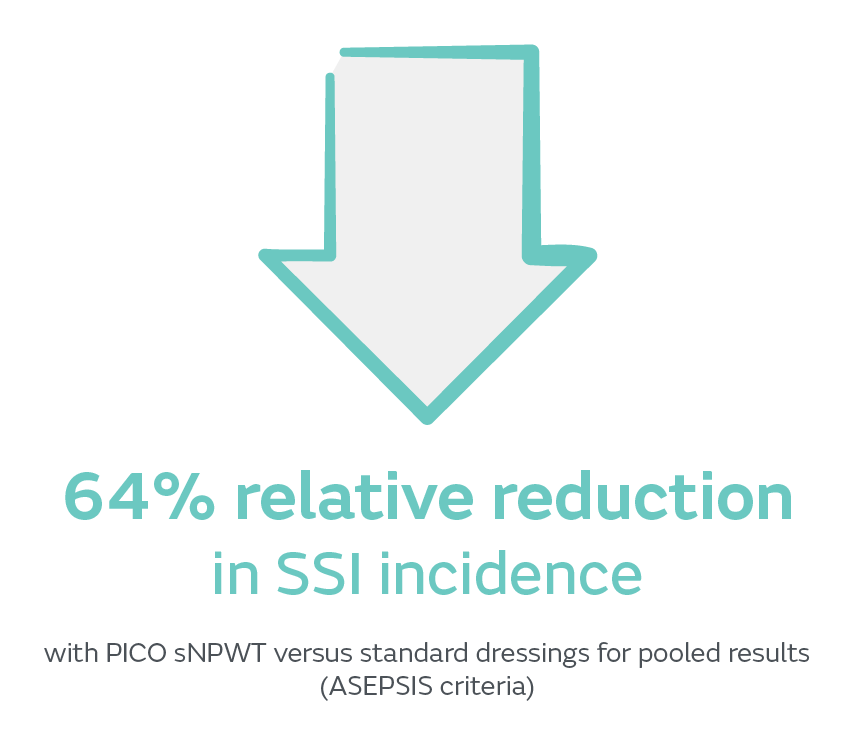
In a randomized controlled trial (RCT) of 178 patients, the prophylactic use of PICO sNPWT significantly reduced the incidence of SSIs by 64% following vascular surgery in the inguinal region.*3
Seroma reduction
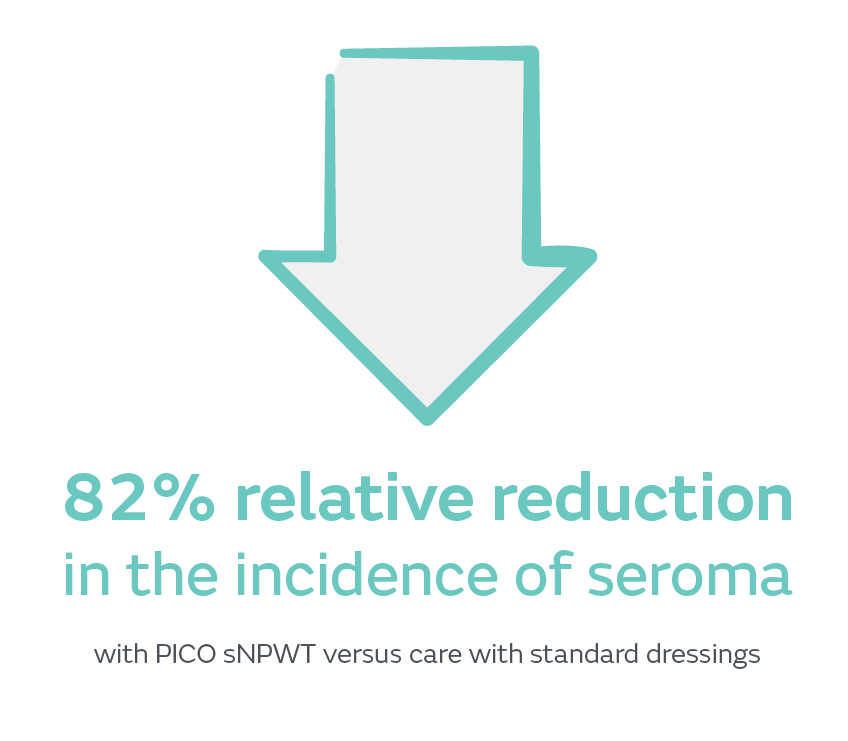
PICO sNPWT helped to significantly reduce the incidence of SSCs, including an 82% relative reduction in the incidence of seroma,* in patients undergoing vascular surgery in the inguinal region.4
General, colorectal, vascular surgery
- Aicher B, Curry P, Croal-Abrahams L, Hao S, Kalsi R, Menon N, Drucker C, Harris D, Toursavadkohi S, Crawford R, Rosenberger S. Infrainguinal wound infections in vascular surgery: an antiquated challenge without a modern solution. Journal of Vascular Nursing. 2017 Sep 1;35(3):146–56.
- Gwilym BL, Dovell G, Dattani N, Ambler GK, Shalhoub J, Forsythe RO, Benson RA, Nandhra S, Preece R, Onida S, Hitchman L. Systematic review and meta-analysis of wound adjuncts for the prevention of groin wound surgical site infection in arterial surgery. European Journal of Vascular and Endovascular Surgery. 2021 Jan 7.
- Hasselmann J, Björk J, Svensson-Björk R, Acosta S. Inguinal Vascular Surgical Wound Protection by Incisional Negative Pressure Wound Therapy–A Randomized Controlled Trial–INVIPS Trial. European Journal of Vascular and Endovascular Surgery. 2019 Dec 1;58(6):e726–7.
- Fleming CA, Kuteva M, O’Hanlon K, O’Brien G, McGreal G. Routine use of PICO dressings may reduce overall groin wound complication rates following peripheral vascular surgery. J Hosp Infect. 2018;99:75–80.
* Compared to care with standard dressings